2024-2026
A better music product, on web3 rails
Co-founder, Product & Engineering
Problem
How do you make global music distribution usable for artists and labels while letting fans participate directly in the royalties a release generates?
Outcome
A live distribution and participation product with 300+ daily active users, making web3 tech 100% invisible, and 2.5K+ monetized tracks.
Website | Master Plan | Protocol
Context
SONGS combined global music distribution with direct royalty participation. Artists and labels distributed releases; listeners could support them and share in the royalties they generated.
I co-founded the product and led it from whitepaper to live system across product direction, design, implementation, protocol behaviour, and commercial delivery. A direct group of 400+ artists, labels, and listeners kept the work grounded in real use.
Digital ownership over music assets was not a new idea; people had tried versions of it since blockchain's early days. By 2021 the NFT wave had made the whole space look worse, not better: a lot of speculation, and a type of user and attention that most of the music industry rightly wanted nothing to do with. What had changed by the time we started was not the pitch, it was the technology underneath it. The same rails that had earned that reputation also made two things possible that were otherwise nearly impossible: real digital ownership over a release, and transparency over how the money tied to it actually moved.
That transparency mattered because music sits inside a lot of jurisdiction and a lot of regulation, and most of the industry's existing structures benefit from staying opaque. Digital distributors work under agreements with platforms and major labels like Spotify, Apple Music, YouTube Music, Sony, and Universal that are not public, and that opacity produces royalty and listening economics that are already asymmetric before an artist ever sees a statement. Building on rails where ownership and payment are visible by default was a direct response to that, not a technology choice made for its own sake.
The product problem
Distribution, rights, payments, and ownership were already complex. The product had to connect a release campaign, its distribution, and later royalty participation without making anyone operate a financial system.
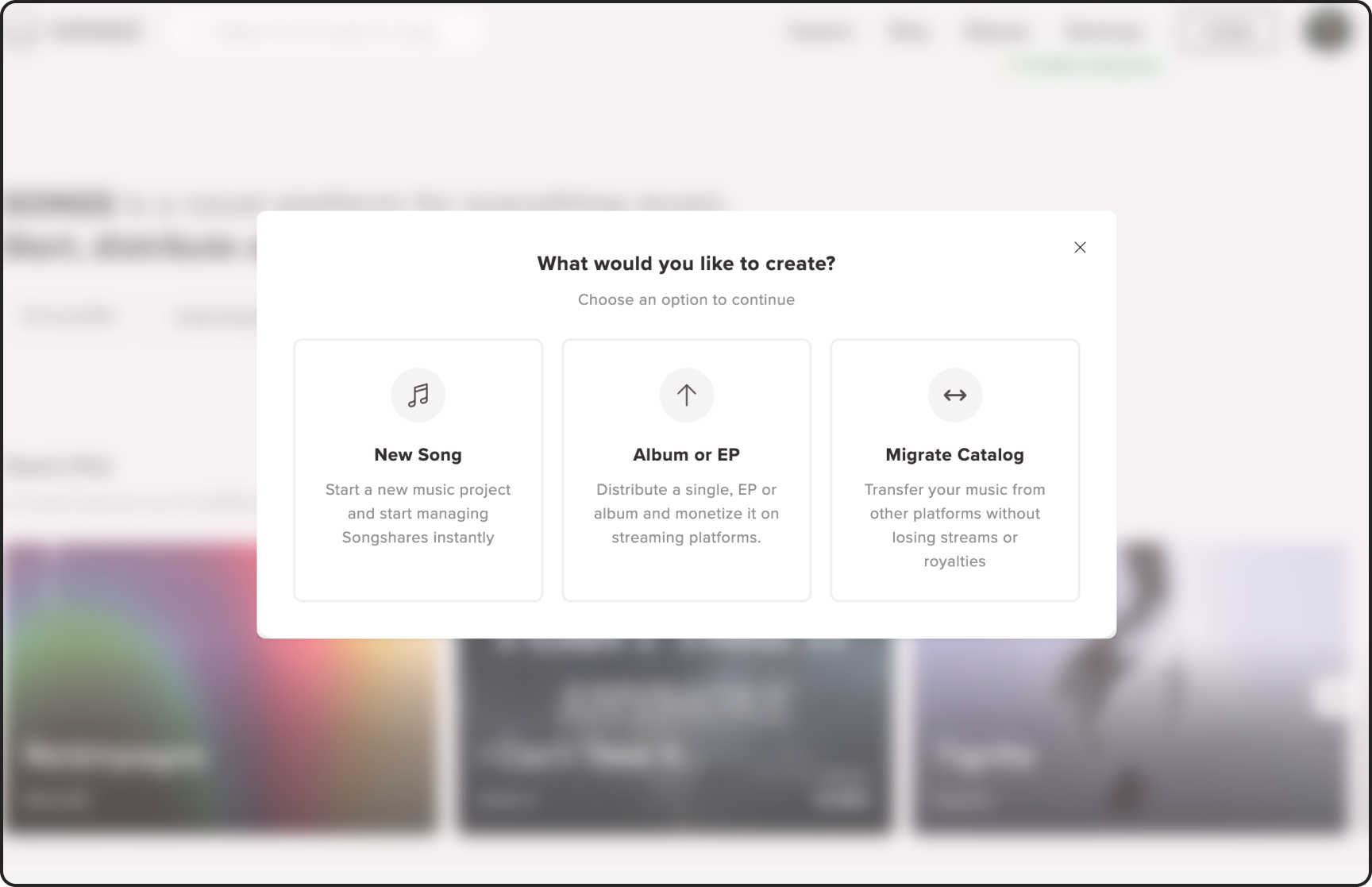
Bet on invisible wallets and programmable money
The first bet was that smart wallets had matured enough to disappear completely. Someone could get something that behaved like a bank account, able to receive dollars, euros, or digital money, by signing up with only an email. That mattered most in unbanked and underbanked regions: an artist there could distribute music and start earning from it without ever opening a bank account or having anywhere official to receive a payment. An email was enough.
The second bet was programmable money itself. Once payments and ownership could move as code, we were no longer limited to what distribution had always meant: a dashboard where labels and artists download a spreadsheet every month or two, broken out by territory and platform, and reconcile it themselves. That process had barely changed in decades and looked the same across every distributor on the market. Programmable money let us build a different category of product on the same underlying rights, not a nicer version of the same statement.
Start with the release
The release was the primary object: the music, its story, and the route from draft to distribution. Wallet and transaction behaviour appeared only when needed.
That order was the actual competitive move against how distribution normally works. A release existed in SONGS from the sketch stage: authorship and provenance were registered the moment a song was created, before it ever reached Spotify, YouTube Music, or Apple Music, and before any label was involved. That let an artist build a direct relationship with their community and finance a release through their own fans, instead of treating a record deal as the only route into a music career.
Distribution came later, once a track or an album was actually ready, in three or four clicks. What made that transition different was the accounting behind it: instead of a monthly export to reconcile by hand, payouts landed automatically and transparently in one structured place. That same automation freed labels from most of the accounting and legal overhead per artist, so they could spend their time on curation, press, direct artist support, and reading what was actually happening at a show, instead of chasing statements.
Make participation concrete
SongShares made a release-specific proposition: what someone supported, what they received, and how future royalties reached them. The product stayed connected to music, not exchange vocabulary.
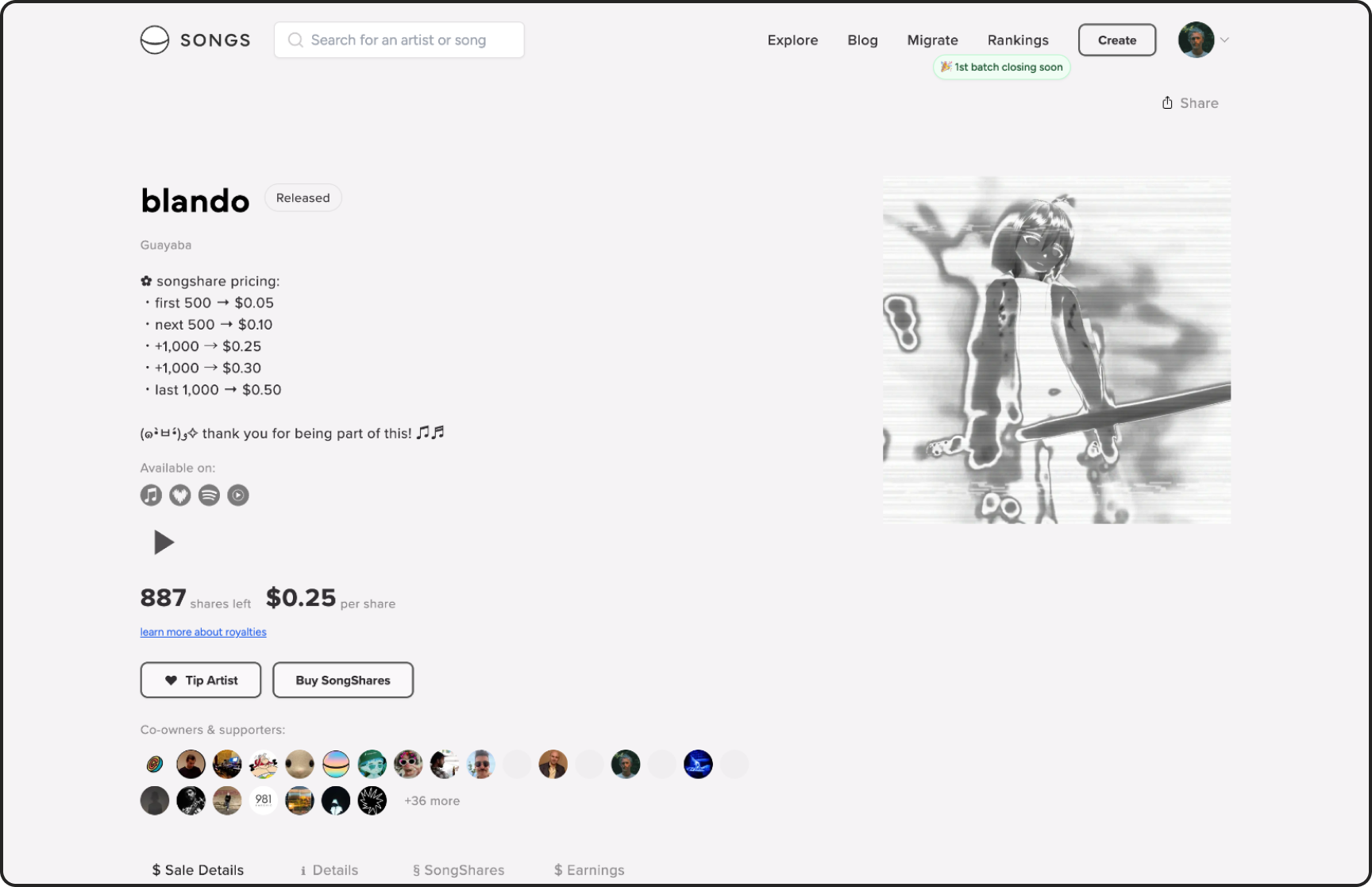
Automate ownership at the moment of creation
Splitting royalties inside a band is usually harder than it should be. A release with five or ten contributors typically gets managed through long, dense contracts, and whoever has the least legal knowledge tends to end up with the worst deal. We automated that: the moment a song was created, it generated a royalty position as a digital asset sitting directly in its creator's SONGS account, ready to send to any other SONGS user. A band could split a song the same way they split the work, transparently, without a lawyer in the loop for every side agreement.
That only works if the money on the other end actually arrives, which is where earlier attempts at this had stopped short. We built the platform to track ownership and accounting, but we also took on the distributor role ourselves: we ingested payments from the catalogues we distributed and converted them directly into each owner's share, in digital dollars, down to fractions of a cent when that's what a song had earned. Owning that payment risk, instead of leaving it to whoever had bought into a royalty position, was what made the ownership model trustworthy rather than theoretical.
Make money feel coherent
Most users were new to crypto. Funding, participation, earnings, and withdrawal had to read as one money story, including pending and failed states. We also prototyped spending against future royalty income without turning the product into a trading terminal.
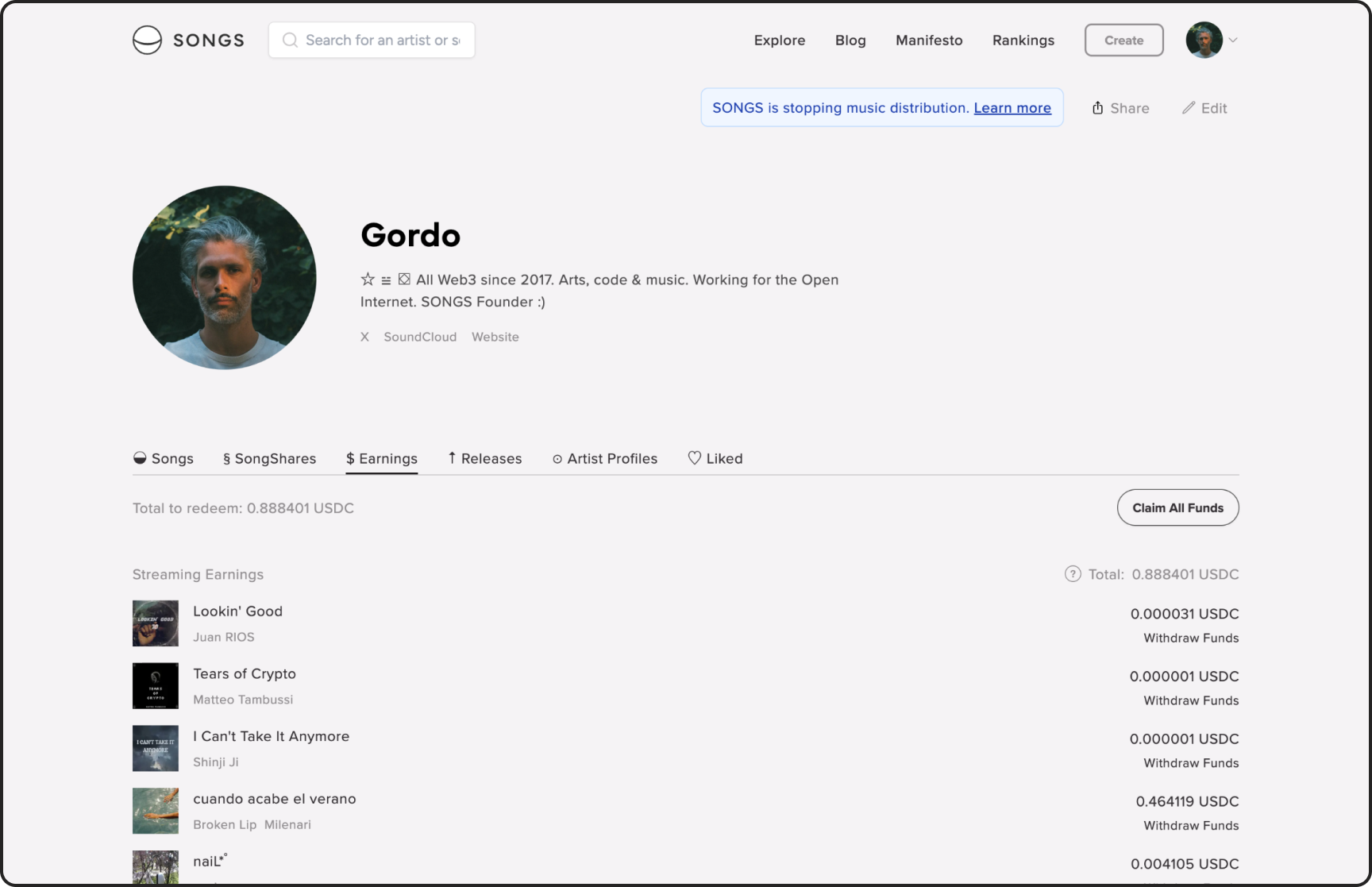
Keep one shared system
Artists created campaigns, labels managed catalogue and rights, and fans discovered and participated. Each surface described the same release, ownership, and payment state.
Outcome
SONGS reached 300+ daily active users and 2.5K+ monetized tracks; 96% of users had never used web3 technology before and did not know they were using it. We paused operations in 2026 after we were unable to close a $2.2M seed round.
The ownership model opened product directions beyond distribution itself. Artists and labels could sell participations in a project at the moment they created it, a form of crowdfunding with real, ongoing participation rather than a one-time reward. Fans who held a piece of a song got paid every time it earned, which built a closer, more recurring relationship with the artist than a stream or a purchase ever does. And because ownership and metadata were tied to the artist's identity rather than to whichever distributor happened to be collecting payments that month, moving between distributors became a one-click change instead of a renegotiation. It also pointed toward financing models we never built: lending against a catalogue's own track record, with anyone able to back a specific artist's future earnings rather than their word alone. We never shipped that, but the ownership model made it a coherent extension rather than a leap.
We proved that blockchain could work as quiet infrastructure. The state of the technology is ready for the masses; its UX can be abstracted enough to disappear and let people focus on what it adds instead of how it works. It also showed that good abstraction is only part of the work: the market, incentives, regulation, and operations must support the product too.